I sit here trying to buy a new pair of sneakers and am being bombarded by the plethora of choices and all I really want is a pair of shoes that fit and provides good support so my back doesn’t hurt when I walk around in them all day. I’ve spent weeks trying to discern all the technical nomenclature and jargon to no avail. They even advertise shoes for yoga. What? They look like sneakers to me and you definitely shouldn’t wear them to yoga. Shame on you marketers for trying to jump on the yoga band wagon and trying to sell me something that isn’t right for yoga. And shame on you athletic foot wear marketers for not making your life easier. I want to give you money but I can’t figure out what I need. Oh wait I’n a marketer in my day job. Hmmmmm.
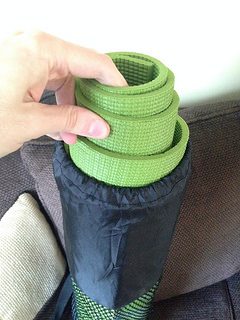
So. . . I see that yoga mats are going that way with so many choices, thicknesses, materials. You can buy yoga mats anywhere, even the grocery store! Lots of mats are advertised as yoga mats when they shouldn’t be. So buyer beware!
Here are the key things to look for when buying a yoga mat.
1) Density is the key.
Density = Mass/Volume. Not thickness. Yes the scientist in me must come out once in a while. Just like when you buy sneakers, trainers, tennis shoes, etc, you want something that is supportive on your joints. A yoga mat is for 4 limbs. That’s double the number of limbs for a pair of shoes so this is an important decision. 1/2 inch thick Pilates or Gym mats are not the same as yoga mats. They are for cushioning your bony tail bone when you are doing sit ups. They are not yoga mats. They don’t provide enough support especially for your wrists when you do a bazillion downward dogs. At the $30 price range, I like the Gaiam Premium Yoga Mat. For the budget conscious, this is a good option to start if you are beginning your practice. I recommend to my students not to go below that range. I have yet to find a mat that I like in the very budget friendly but I’ll keep looking.
2) Thickness does matter
I like my mat to be around 5mm but that’s my personal preference. I personally practice on The Mat from Lululemon. They also make a 3mm version for $58 but tends to not provide enough support for me. Especially if you are starting out, you need more support since you are still on your yoga journey to develop joint strength and stability. I did try a down dog or two on teh Gaiam Sol coming in at $50. It looked like a Lululemon knock off and didn’t provide enough support.
3) Grippy not slippery
You want a mat that you’re not going to slip on even if you sweat. Another popular favorite in the yoga community is the Manduka Pro and ProLite Mats. They carry a heft price tag between $78 – $128 but they are the creme de la creme of yoga mats. Some weigh in at 9 lbs they definitely satisfy the density criteria (see formula above). Mandukas have a reputation of needing to be broken in through a pretty involved ritual and I’m not talking about your asana poses. A brand new mat usually starts slippery. Many have posted on letting the mat bake in the sun, rubbing it with salt, and/or a few months of practice. The Mat from Lululemon is sticky right out of the store. Over time, it loses its grippiness but that’s when the life time warranty is great so I just go in and exchange for a new one which I have done once thus far after 2 years of practicing 5-6 classes a week. There are also yoga towels that are advertised for use on top of your mat. What they don’t tell you is the towel needs to be wet for it to grip. So you might end up with a mat that is slippery when you sweat but a dry towel at the beginning of the class that isn’t sticky enough. I found it too cumbersome to manage a towel and a mat. I also have 4 pairs of yoga toe socks but those are definitely not grippy enough and lose its stickyness after a few washes.
4) Length
Mats are made in variable lengths. Depending on your height you might need a slightly longer mat. Especially those that are newer to yoga, I’m constantly telling students to take a longer stance in the warrior poses.
5) Test drive your mat
Many yoga studios and athletic stores have mats available for you to test drive your downward dog. Or go to a yoga studio and many have premium mats that you can rent for a class. This is well worth your time and investment to find the right mat for you. Or ask a fellow student in your class if you can try a quick down dog or sun salutation on their mat.
Some of my other students have tried the Jade Harmony Professional Yoga Mat ($50). They are eco friendly and made of natural rubber but if you have latex allergies you might want to double check how you will react. Also, natural rubber tends to have a strong odor that may not agree with you. The odor made one of my students eyes sting.
There are also lots of gimmicky mats out there like ones that have placements for alignment. I would stay far away from those since every body type is different and where you put your feet isn’t where I would put my feet because I’m 5 feet tall and your 6 feet tall. The pose is also different day to day because your body is different. It might be tighter one day to the next.
What mat do you use? Leave a comment and let me know.
photo credit: <a href="https://www.flickr.com/photos/smemon/15437332182/">Sean MacEntee</a> via <a href="http://photopin.com">photopin</a> <a href="http://creativecommons.org/licenses/by/2.0/">cc</a>
 yoga for dessert
Leave a comment